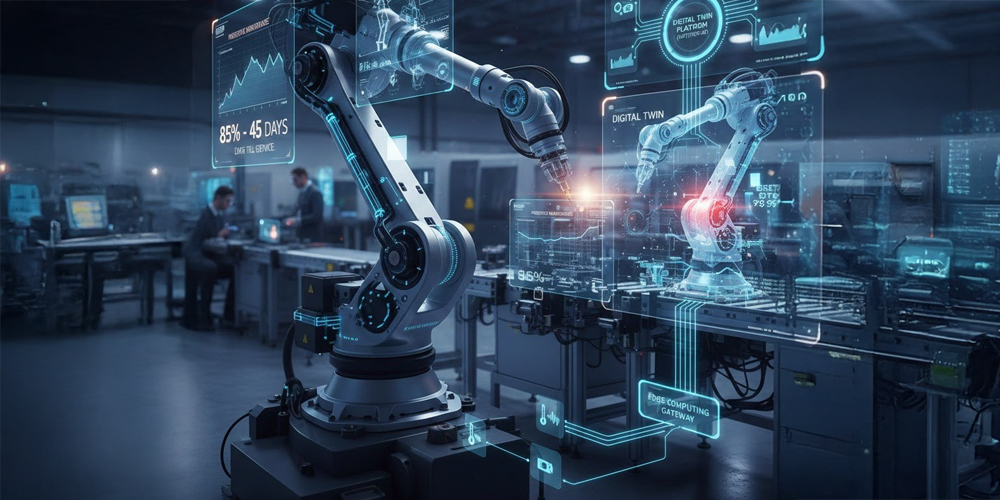
Moving Beyond the Break-Fix Cycle
Historically, maintenance followed two paths : Reactive (waiting for failure) or Preventive (replacing parts based on a calendar, often wasting components which are in good condition).Predictive Maintenance changes the game by using IoT sensors to monitor asset health in real-time. By tracking parameters like vibration, temperature, frequency etc, machine learning algorithms can detect "micro-anomalies"—patterns invisible to the human eye—that signal a failure weeks before it occurs.
- The impact is measurable:
- 70% reduction in unplanned downtime.
- 25–30% reduction in overall maintenance costs.
- Extended asset lifespan by avoiding catastrophic failures that damage related components.
The Digital Twin: More Than Just a 3D Model
While predictive maintenance tells you when a machine might fail, a Digital Twin tells you why and how to fix it.A Digital Twin is a dynamic virtual replica of a physical asset, process or even an entire factory floor. It isn't just a static CAD drawing; it is a living model fueled by a continuous stream of real-time data from the physical twin.
In smart manufacturing, Digital Twins act as a "virtual sandbox." Engineers can simulate "what-if" scenarios—such as increasing line speed by 15%—to see the impact on mechanical stress and energy consumption without risking actual hardware. When integrated with predictive maintenance, the Digital Twin provides the context needed for remote diagnostics, allowing technicians to visualize the internal state of a machine from thousands of miles away.
The Architecture of Smart Manufacturing
Building a smart manufacturing ecosystem requires a robust, multi-layered technical architecture based on "Edge-to-Cloud" framework that ensures that data is not just collected, but acted upon instantly.
- 1. The Perception Layer (Edge)
At the bottom of the stack are the high-precision sensors (accelerometers, thermal imagers, pressure transducers) and wireless interfaces (BLE, Zigbee) and/or wired interfaces (AI, AV, DI, MODBUS, CAN bus). These devices capture raw sensors data at the source.
- 2. The Edge Computing Layer
To minimize latency, critical processing happens at the Edge. Instead of sending every vibration data point to the cloud, the edge gateways can collect sensors data points and run "anomaly detection" and “alarm events detection” locally. This allows for millisecond-response times, such as triggering an emergency shut-off if a bearing temperature spike. The edge gateway pushes the transformed sensors data points via wireless interfaces (WiFi, 4G LTE, LoRaWAN, 5G) and/or wired interfaces (Ethernet) to cloud platform.
- 3. The Integration Layer (Digital Twin Core)
This is where the physical and digital worlds meet. Using protocols like MQTT or OPC UA, data is ingested into the Digital Twin platform via the above wireless and/or wired interfaces. Here, the data is mapped onto a virtual model, creating a real-time "mirror" of the shop floor.
- 4. The Analytics & Application Layer
The top of the stack utilizes Machine Learning (ML) models—often using architectures like CNN, RNN, Long Short-Term Memory (LSTM) or GRU networks—to process historical and real-time data to forecast Remaining Useful Life (RUL). The dashboards then present this as actionable insights for plant managers.
Why the Convergence Matters
The true power lies in the synergy between these technologies. A predictive maintenance alert might flag a motor, but the Digital Twin allows the maintenance lead to see the machine's service history, its current thermal map and even a 3D walkthrough of the repair procedure via Augmented Reality (AR). This convergence transforms the maintenance department from a "cost center" into a strategic driver of efficiency.
Partnering for the Future of Smart Industry
At Meritech, we bridge complex industrial hardware and intelligent digital ecosystems. With deep expertise in IoT, wireless, and IT services, we deliver end-to-end solutions tailored for factory-floor demands.
Our programmable MBCB IoT gateway offers wireless (WiFi, LTE, LoRa) and wired (Ethernet) connectivity, seamlessly linking diverse data sources—from industrial machines and equipment to plant infrastructure—directly to the cloud.
We build bespoke Digital Twin platforms, dashboard applications, and predictive analytics engines, empowering manufacturers to digitize confidently and eliminate unplanned downtime. Our mission: transform your facility into a truly intelligent operation.